Mineral Fertilizers Ukraine: Gas Shock & Nitrogen Supply
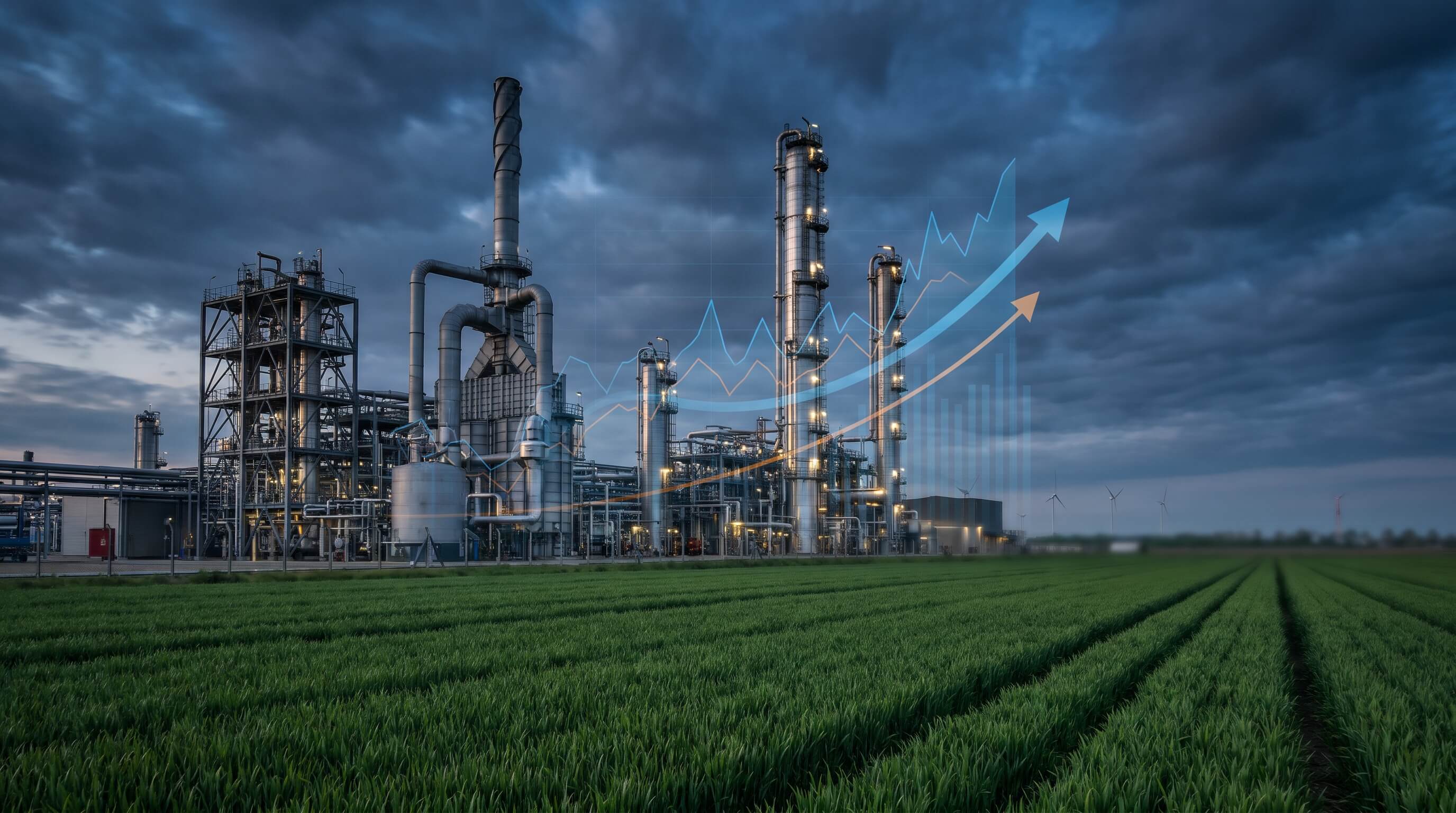
European Energy Pressures Reshape the Global Nitrogen Landscape
The international nitrogen fertilizer complex has entered an era of renewed volatility driven by dramatic developments in the European energy sector. A sharp rally in benchmark front-month natural gas contracts at the Dutch TTF hub has elevated gas values to levels not witnessed since late 2022. Because natural gas constitutes up to 80% of variable cash costs in ammonia synthesis, Northwest and Central European production margins have deteriorated rapidly. Operating costs for domestic European nitrogen synthesis now drastically exceed import parity, forcing chemical producers into defensive curtailments. For Ukrainian agribusiness, which operates adjacent to this supply basin, these international shifts carry substantial operational implications.
Official data from the Ministry of Agrarian Policy and Food of Ukraine indicates that the domestic winter sowing campaign has reached 5.35 million hectares, including 4.21 million hectares of winter cereals (wheat, barley, rye) and 1.13 million hectares of winter rapeseed, with rapeseed exceeding initial sowing targets. Overwintering crops will require extensive early-spring nitrogen and sulfur applications to realize yield potential. However, the domestic availability and landed cost of granular urea, urea-ammonium nitrate (UAN), and ammonium sulphate will be directly governed by the structural supply vacuum currently emerging across Western Europe.
Navigating this environment requires agricultural procurement executives and commercial farm managers to abandon complacency. Waiting for late winter or early spring spot procurement exposes farming operations to heightened price volatility and severe product allocation limits at Black Sea and Danube river discharge hubs. An analytical review of current fundamental drivers highlights why early supply commitment remains the most defensible risk-management strategy.
Market Drivers: Capacity Curtailments and Divergent Trade Flows
The primary catalyst behind tightening market balances is widespread capacity idling across European manufacturing hubs. Leading European industrial conglomerates based in Norway and the Czech Republic have initiated significant output restrictions. Approximately 28% of total European ammonia capacity is currently verified offline, with projections warning that outages could expand beyond 40% if high natural gas prices persist through the heating season. Multiple major manufacturers have withdrawn formal price offers across their entire fertilizer portfolios, including granular urea, calcium ammonium nitrate (CAN), and liquid UAN, creating an immediate supply void.
This European production deficit is aggressively altering global maritime trade routes. To fill the domestic gap, European buyers have intensified purchasing from North African suppliers in Egypt and Algeria, alongside Nigerian originators. This pull has reinforced free-on-board (FOB) price firming across the Mediterranean basin, with producers systematically rejecting discounted buyer bids. Meanwhile, broader international sentiment presents a nuanced picture: while European supply is tightening, Latin American markets, led by Brazil, have shown temporary demand hesitation due to domestic currency volatility and softer international grain prices. Similarly, Indian tender delays have left some Asian swing volumes temporarily uncommitted.
In a telling geopolitical and commercial shift, the United Kingdom government recently enacted emergency tariff suspensions on critical fertilizer imports—encompassing urea, ammonium sulphate, NPKs, and phosphates—effective late November through December 2027 to shield domestic farmers from soaring input costs, while maintaining punitive tariffs exclusively on Russian and Belarusian volumes. This policy move underscores the intensifying international scramble for non-sanctioned plant nutrients. While bearish market commentators argue that farmer pushback and softer grain economics could cap price appreciation, the contraction of upstream chemical manufacturing capacity is proceeding at a much faster pace than demand destruction.
Deep Market Analysis: Logistics, Geopolitics, and Ukrainian Agriculture
Macroeconomic Headwinds and Energy Constraints
According to the World Bank's latest Commodity Markets Outlook, global commodity markets face structural headwinds from ongoing Middle East tensions and broad energy market disruptions. The report emphasizes that nitrogen fertilizer pricing remains fundamentally tied to natural gas volatility and supply chain friction. Maritime traffic complications through the Strait of Hormuz continue to generate risk premiums on Middle Eastern product flows, reinforcing Western and Central European dependence on Atlantic and Mediterranean supply corridors.
Regional Logistics and Port Dynamics
For Ukrainian agricultural importers, Black Sea transit dynamics remain critical. Constanța in Romania and Danube river ports (Izmail, Reni) serve as the primary entry corridors for imported nitrogen. Spot cargoes of Middle Eastern and Central Asian urea arriving via Georgian ports face steep cross-Black Sea bulk freight rates. Furthermore, northern trade routes remain constrained: rail delivery restrictions toward Baltic export terminals imposed by regional railway operators, combined with reported operational disruptions at key industrial complexes, have severely reduced the flow of spot nitrogen eastward into Europe.
Product-Specific Supply Evaluations
The nitrogen complex displays marked variations across individual product categories:
- Granular and Prilled Urea: Granular material commands substantial premiums due to surging Mediterranean FOB levels and robust demand from European industrial and agricultural buyers seeking substitutes for restricted local supplies.
- Urea-Ammonium Nitrate (UAN-32): European domestic production has slowed to a crawl. While US Gulf originators are positioned to bridge the deficit, long shipping distances, tight tanker availability, and rigorous verification requirements under the EU Carbon Border Adjustment Mechanism (CBAM) create structural delays for prompt deliveries into the European theater.
- Ammonium Sulphate: The global market is closely monitoring Chinese export allocations. With second-round quotas significantly curtailed and Chinese port congestion persisting, global compacted and caprolactam-grade supplies are tightening. Given Ukraine's extensive winter rapeseed acreage of over 1.13 million hectares, securing sulfur-bearing nitrogen early is agronomically essential.
Strategic Outlook and Actionable Sourcing Insights
Over the next 1–3 months, the balance of risks points firmly upward. As the European winter heating season commences, sustained natural gas withdrawals will prevent any immediate normalization of domestic chemical operating rates. Even if demand in select Asian or South American markets remains subdued, the acute supply deficit across Europe will maintain a firm floor under regional import benchmarks, directly impacting import replacement costs into Ukraine.
Consequently, the November-December window represents an optimal procurement corridor for Ukrainian agribusinesses. Regional distributors and international trading channels still hold inventory positions booked prior to the full impact of current gas spikes. Deferring procurement decisions until January or February exposes agricultural enterprises to concentrated supply risks: European buyers will be actively scouring the market for spring top-dressing volumes, vessel freight availability will tighten, and spot import premiums will surge.
Securing farm input requirements in this challenging market demands collaboration with established, professional import partners. Experienced importers possess the logistics infrastructure, international trade relationships, and multi-modal transit capabilities needed to guarantee product delivery on schedule. We invite agricultural producers to contact our commercial team today to review supply allocations, obtain firm quotes, and secure high-grade nitrogen fertilizers ahead of the spring application campaign.